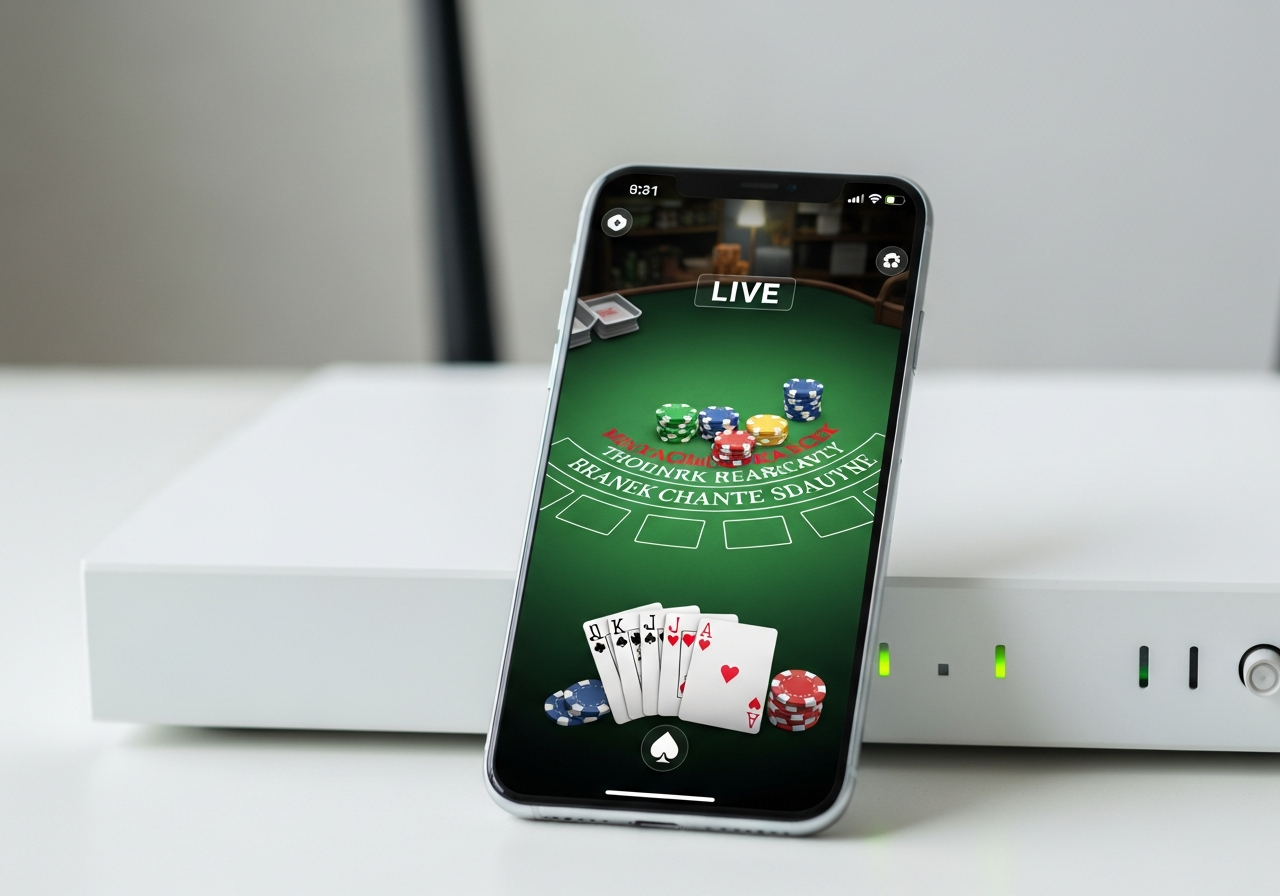
For Ghanaian players looking to join live blackjack tables, nothing is more frustrating than experiencing lag, disconnections, or missed betting opportunities due to poor internet connectivity. Live blackjack combines the excitement of real casino action with the convenience of playing from home, but it demands a reliable connection to deliver the seamless experience you expect.
Live blackjack is essentially a low-bitrate live stream paired with real-time betting commands, meaning both speed and stability are crucial for smooth gameplay. Unlike traditional online blackjack that uses simple graphics, live dealer games stream actual video from professional studios while processing your betting decisions in real-time. This guide provides specific Mbps requirements, ping targets, and data consumption figures tailored to Ghana’s typical connection types, including mobile 4G/5G networks, fixed wireless, and fiber broadband.
How Live Blackjack Uses Your Internet Connection
Live blackjack operates through a sophisticated combination of live video streaming from professional casino studios and low-bandwidth game commands that communicate your betting decisions to the server. The video stream delivers the visual experience of watching a real dealer shuffle cards and manage the table, while separate data packets handle your hits, stands, and bet placements.
Understanding the difference between download and upload requirements is essential for optimizing your connection. Download speed handles the incoming video stream from the casino studio, while upload speed manages your outgoing commands and bet selections. Ping, or latency, becomes critical because any delay can result in missed betting windows or delayed responses to your decisions.
Live blackjack bandwidth requirements are similar to streaming low-bit HD content, but with much stricter stability demands. While you might tolerate occasional buffering when watching a movie, even brief interruptions during live blackjack can cost you money or disrupt the game flow.
Download, Upload and Latency in Live Casino Play
Download speed refers to how quickly data flows from the casino’s servers to your device, primarily affecting video quality and smoothness. Upload speed determines how fast your betting commands reach the server, influencing response times when you make decisions at the table. Latency, measured in milliseconds, represents the round-trip time for data to travel between your device and the casino server.
While live blackjack uses relatively low data volumes compared to other online activities, it’s extremely sensitive to delays and interruptions. A latency spike of just a few hundred milliseconds can prevent you from placing a bet before the deadline or cause your decisions to register after the dealing has begun.
Why Stability Matters More Than Raw Speed
Jitter and packet loss are the real enemies of smooth live blackjack gameplay. Jitter occurs when data packets arrive at irregular intervals, causing choppy video playback and inconsistent response times. Packet loss happens when some data fails to reach its destination, resulting in missing video frames or lost betting commands.
A stable 10 Mbps connection with consistent low ping will always outperform an unstable 50 Mbps connection for live blackjack. The game’s real-time nature means consistent performance trumps peak speed every time, making connection stability your primary concern when choosing an internet plan for live casino gaming.
Minimum and Recommended Internet Speeds for Live Blackjack
Based on streaming and gaming benchmarks adapted for live casino play, most players need at least 5 Mbps download speed with ping under 80ms for acceptable performance. However, these minimums assume ideal conditions that rarely exist in real-world Ghana networks, making higher speeds advisable for consistent gameplay.
Speed requirements scale significantly based on usage scenarios, from single-device play to shared household connections or multi-table gaming sessions. Most Ghana 4G and fiber plans technically meet minimum requirements, but actual speeds often fall short of advertised rates, especially during peak usage periods.
| Use Case | Minimum Download (Mbps) | Recommended Download (Mbps) | Minimum Upload (Mbps) | Target Latency (ms) |
|---|---|---|---|---|
| Single Player – Standard Quality | 5 | 10 | 1 | Under 80 |
| Single Player – HD Quality | 8 | 15 | 1 | Under 60 |
| Shared Household (2-3 devices) | 15 | 25 | 3 | Under 80 |
| Multi-Table Play | 20 | 35 | 2 | Under 50 |
| VIP/Immersive Tables | 12 | 20 | 2 | Under 40 |
Safe Headroom Above the Table’s Actual Needs
Maintaining bandwidth headroom of 30-50% above the live stream’s actual bitrate is crucial for handling network fluctuations and background device activity. This buffer ensures consistent performance when your connection experiences temporary slowdowns or when other devices in your household consume bandwidth simultaneously.
Latency often becomes the primary bottleneck for live blackjack performance, even when download speeds appear adequate. Ghana’s internet infrastructure can introduce additional latency due to routing through international servers, making low ping values more challenging to achieve than raw speed targets.
Latency, Ping and Jitter: The Hidden Killers of Live Blackjack
Understanding latency thresholds is essential for smooth live blackjack gameplay. Under 50ms ping provides ideal responsiveness, while 50-80ms remains acceptable for most players. Anything above 100ms starts creating noticeable delays that can impact your gaming experience.
Jitter represents the variation in latency over time, and consistent delays often prove less disruptive than highly variable connection timing. Testing your connection with speed tools that measure ping to European servers provides the most relevant data, since many live casinos operate from European studios.
- Ping under 50ms: Ideal for responsive gameplay and quick betting decisions
- Ping 50-80ms: Acceptable performance with minimal noticeable delay
- Ping 80-120ms: Playable but may experience occasional timing issues
- Ping above 120ms: Significant delays that can disrupt betting windows
- Jitter under 10ms: Stable connection with consistent response times
- Jitter 10-20ms: Moderate variation that most players can adapt to
- Jitter above 20ms: Unpredictable timing that affects gameplay flow
How High Latency Shows Up at the Live Table
High latency manifests in several frustrating ways during live blackjack sessions. You might notice delayed card animations that don’t sync with the dealer’s actual movements, or experience situations where your betting decisions register after the dealer has already called “no more bets.”
Common symptoms include missed betting opportunities when the interface doesn’t respond quickly enough to your taps or clicks, audio that doesn’t match the dealer’s lip movements, and general feeling that the game is running behind real-time. These network issues directly translate to the in-game frustrations that can ruin an otherwise enjoyable session.
Testing Ping and Jitter Before You Join
Running speed tests specifically targeting European servers provides the most accurate representation of your live blackjack performance potential. Many speed test tools allow you to select server locations, so choose UK, Malta, or other European locations where live casino studios commonly operate.
Testing during your regular play hours accounts for daily network congestion patterns in Ghana, where evening peak usage often significantly impacts performance. Run multiple tests over several days to understand your connection’s consistency rather than relying on a single measurement.
Typical Ghana Internet Options for Live Blackjack
Ghana’s internet landscape offers several connection types with varying suitability for live blackjack gameplay. Mobile 4G and emerging 5G networks provide widespread coverage, while fiber optic connections offer superior performance in urban areas. Fixed wireless and ADSL remain options in some regions, though with different performance characteristics.
Each connection type presents unique advantages and limitations for live casino gaming. Fiber typically delivers the most stable experience with low latency, while good 4G coverage can provide adequate performance for casual play. Rural areas often face more significant challenges due to limited infrastructure and weaker signal strength.
| Connection Type | Typical Download (Mbps) | Typical Upload (Mbps) | Latency Trend | Suitability for Live Blackjack |
|---|---|---|---|---|
| Fiber (Urban) | 50-100 | 20-50 | 30-60ms | Excellent |
| 4G Strong Signal | 15-40 | 5-15 | 40-100ms | Good |
| 5G (Where Available) | 50-200 | 10-30 | 20-50ms | Excellent |
| 4G Weak Signal | 2-10 | 1-5 | 80-200ms | Poor |
| Fixed Wireless | 10-30 | 3-10 | 50-120ms | Fair |
| ADSL | 4-16 | 0.5-2 | 60-150ms | Marginal |
Urban vs Rural Connection Quality in Ghana
Urban areas like Accra, Kumasi, and Takoradi benefit from robust fiber infrastructure and strong 4G coverage that typically support smooth live blackjack gameplay. These locations offer multiple ISP options and generally more stable connections with lower latency to international servers.
Rural Ghana faces more significant connectivity challenges, with weaker mobile signals, limited fiber availability, and higher latency due to longer routing paths. Players in remote areas should consider conservative approaches, such as playing during off-peak hours and using lower video quality settings to maintain stability. Testing your specific location’s performance during different times helps identify optimal playing windows for your connection.
Data Usage: How Much Bandwidth Live Blackjack Consumes
Understanding data consumption helps Ghana mobile users manage their bundles effectively and avoid unexpected charges or speed throttling. Live blackjack streams consume between 200MB to 1GB per hour depending on video quality settings, which can quickly exhaust smaller data packages or trigger fair usage policies on unlimited plans.
Most Ghana mobile operators offer bundles ranging from 1GB to unlimited options, but unlimited plans often include fair usage thresholds that throttle speeds after certain consumption levels. Knowing your hourly consumption allows better planning for longer gaming sessions and helps determine when switching to Wi-Fi becomes necessary.
| Video Quality | Estimated Bitrate (Mbps) | Data Per Hour (GB) | Notes for Ghana Mobile Users |
|---|---|---|---|
| Low Quality | 0.5-1.0 | 0.2-0.4 | Suitable for 1-2GB bundles, 2-5 hours play |
| Standard Quality | 1.5-2.5 | 0.7-1.1 | Requires 3GB+ bundles, 3-4 hours max |
| HD Quality | 3.0-5.0 | 1.3-2.3 | Best for unlimited plans, monitor usage |
| Ultra HD/Immersive | 6.0-8.0 | 2.7-3.6 | Use Wi-Fi only, very high consumption |
Managing Mobile Data While Playing Live Blackjack
- Lower video quality settings to the minimum acceptable level for your enjoyment and connection stability
- Close all background apps, especially social media, streaming services, and automatic cloud backups
- Disable automatic app updates and OS updates during gaming sessions to prevent background data usage
- Monitor your data consumption in real-time using your phone’s built-in data tracker or carrier app
- Switch to Wi-Fi or fiber broadband for sessions longer than 2-3 hours to avoid exhausting mobile bundles
- Consider purchasing larger data bundles or daily unlimited packages when planning extended gaming sessions
When to Switch from Mobile to Home Internet
The economics of mobile versus home internet for live blackjack depend on your playing frequency and session duration. Mobile data becomes expensive for regular players who spend more than 10-15 hours per month at live tables, making home broadband more cost-effective for serious players.
Typical patterns that favor switching include frequent evening play when mobile networks experience congestion, weekend gaming sessions lasting several hours, or multi-table play that requires higher bandwidth. Home internet also provides more stable latency and better performance for high-stakes games where connection reliability directly impacts your bankroll.
Device and Network Setup for Smooth Live Blackjack
Optimizing your home network and device settings can significantly improve live blackjack performance even with modest internet speeds. Simple steps like router placement, device proximity, and network configuration often resolve connectivity issues more effectively than upgrading your internet plan.
Creating an optimal gaming environment involves both technical optimizations and environmental considerations. The goal is eliminating variables that can disrupt your connection stability and ensuring consistent performance throughout your gaming sessions.
- Position yourself within strong Wi-Fi range or use Ethernet connection when possible for maximum stability
- Restart your router before extended gaming sessions to clear memory and refresh connections
- Use 5GHz Wi-Fi band instead of 2.4GHz to avoid congestion from household devices
- Disable VPN services during play as they add latency and can interfere with casino geolocation
- Close unnecessary browser tabs and applications that consume bandwidth or processing power
- Update your browser or casino app to the latest version for optimal compatibility and performance
- Consider Quality of Service (QoS) router settings to prioritize gaming traffic over other household internet usage
Best Practices for Playing on Mobile in Ghana
- Lock your phone to 4G or 5G networks to prevent automatic switching to slower 3G connections
- Avoid moving between locations during active play sessions as signal handoffs can cause temporary disconnections
- Position yourself near windows or outdoors when signal strength is marginal for improved reception
- Disable Wi-Fi calling and VoLTE if they interfere with gaming performance on your specific network
- Keep your phone plugged in during long sessions as battery optimization can throttle network performance
- Use airplane mode for 10 seconds then re-enable if you experience persistent connection issues
Matching Live Blackjack Table Formats to Your Connection
Different live blackjack formats place varying demands on your internet connection, from basic single-camera tables to immersive multi-angle HD experiences. Understanding these differences helps you choose table types that match your connection capabilities and avoid frustrating performance issues.
Testing your connection with different table formats before committing to longer sessions or higher stakes helps identify your optimal gaming environment. Starting with simpler tables allows you to gauge performance and gradually upgrade to more demanding formats as your connection proves stable.
| Table Type | Video Complexity | Recommended Download (Mbps) | Sensitivity to Latency | Best For Connection Type |
|---|---|---|---|---|
| Standard Tables | Single camera, basic quality | 5-8 | Moderate | Mobile 4G, basic broadband |
| HD Tables | 720p/1080p single stream | 8-15 | Moderate | Strong 4G, fiber |
| Immersive/Multi-Angle | Multiple cameras, HD | 12-20 | High | Fiber, strong 5G |
| VIP Private Tables | Premium HD, multiple features | 15-25 | Very High | Premium fiber only |
| Speed Tables | Fast-paced, quick decisions | 8-12 | Very High | Low-latency fiber preferred |
Adjusting In-Casino Video Settings
Most live casino platforms offer video quality controls in their settings menu, typically labeled as Auto, Low, Medium, High, or HD options. Starting with medium quality provides a good balance between visual experience and connection demands while you assess your network’s stability.
Auto quality settings attempt to adjust based on your connection speed, but they often prioritize video quality over stability. Manual selection gives you better control and prevents the platform from automatically switching to higher bitrates that might strain your connection during peak network usage periods.
Signs You Should Drop to a Lighter Table
- Frequent video buffering or pixelation that disrupts your ability to follow card dealing
- Delayed response when clicking hit, stand, or other betting options
- Audio and video synchronization issues where dealer speech doesn’t match lip movements
- Regular disconnection warnings or automatic reconnection messages
- Betting interface becomes unresponsive during critical decision moments
- Cards appear to skip or jump rather than showing smooth dealing animations
Troubleshooting Lag and Disconnections in Ghana
When live blackjack performance degrades, systematic troubleshooting helps identify whether the issue stems from your local network, your ISP, or the casino’s servers. Most connection problems have simple solutions that don’t require technical expertise or expensive upgrades.
Evening network congestion represents a common challenge in Ghana’s urban areas, where peak usage between 7-11 PM can significantly impact gaming performance. Understanding these patterns helps you time your sessions for optimal connectivity or adjust expectations during busy periods.
- Test your current internet speed using multiple speed test services to establish baseline performance
- Restart your router and modem by unplugging power for 30 seconds then reconnecting
- Switch from Wi-Fi to mobile data or vice versa to isolate the problematic connection
- Try different live blackjack tables or casinos to determine if the issue is platform-specific
- Close all other internet-using applications and devices to maximize available bandwidth
- Clear your browser cache and cookies or update your casino app to the latest version
- Contact your ISP if speed tests show significantly lower performance than your plan’s advertised speeds
When to Contact Your ISP vs the Casino
Network issues originating from your ISP typically affect all internet activities, not just live blackjack gameplay. If you experience slow loading on multiple websites, poor video streaming quality, or general connectivity problems, the issue likely lies with your internet service provider.
Casino-specific problems usually manifest as issues only within the gaming platform while other internet activities perform normally. Before contacting support, collect speed test results, note specific error messages, and document the times when problems occur to provide useful information for troubleshooting assistance.
Building a Future-Proof Internet Setup for Regular Live Blackjack
Serious live blackjack players benefit from treating internet connectivity as essential gaming infrastructure rather than a basic utility. Creating player profiles based on gaming frequency and intensity helps determine the appropriate investment level for your internet setup.
Casual players who enjoy occasional sessions can often succeed with standard consumer internet plans and basic optimization. Regular players and those pursuing live blackjack as a significant hobby or income source should consider premium connectivity solutions that prioritize gaming performance over cost savings.
| Player Profile | Suggested Connection Type | Target Download/Upload (Mbps) | Max Devices During Play | Notes for Ghana |
|---|---|---|---|---|
| Casual Player | Strong 4G or Basic Fiber | 15/5 | 2-3 | Weekend play, shared connection OK |
| Regular Player | Fiber or Premium 4G+ | 25/10 | 1-2 | Dedicated gaming hours, consider QoS |
| Serious Player | Premium Fiber | 50/20 | 1 | Dedicated connection, backup option |
| Professional Player | Business Fiber + Mobile Backup | 100/50 | 1 | Redundancy essential, low latency priority |
Budgeting for Internet as a Gambling Cost
Treating internet connectivity as part of your gambling budget helps frame the investment appropriately and ensures adequate performance for your playing style. Just as you wouldn’t play live blackjack with insufficient bankroll, playing with inadequate internet creates unnecessary disadvantages that can impact your results.
Calculate your monthly internet costs against your typical gambling volume to determine the appropriate service level. Spending an extra 50-100 GHS monthly on premium connectivity often proves worthwhile if you play regularly and value consistent performance over saving money on basic plans.
Separating Gambling Traffic from the Rest of the Household
Advanced router configurations allow creating separate network segments for gaming traffic, ensuring your live blackjack sessions don’t compete with family streaming, video calls, or other high-bandwidth activities. Guest networks or VLAN configurations can isolate gaming devices from general household internet usage.
Quality of Service (QoS) settings prioritize specific devices or applications, allowing your gaming traffic to receive bandwidth preference during network congestion. These configurations require some technical knowledge but can dramatically improve gaming consistency in busy households.
Quick Checklist Before You Sit at a Live Blackjack Table
Developing a pre-session routine helps identify potential connectivity issues before they impact your gameplay and bankroll. This checklist takes just a few minutes but can save significant frustration and potential losses from technical problems during crucial gaming moments.
- Run a speed test targeting European servers and verify download speed exceeds 10 Mbps with ping under 80ms
- Close all unnecessary applications, browser tabs, and background downloads on your device
- Ensure your device has adequate battery life or is connected to power for longer sessions
- Test the specific casino’s live tables with small bets to confirm smooth video and responsive controls
- Check your data allowance if using mobile internet and estimate consumption for your planned session length
- Verify you’re connected to your fastest available network (5GHz Wi-Fi, 4G/5G, or Ethernet)
- Position yourself in a location with strong signal strength and minimal movement requirements
Red Flags: When You Should Skip Live Blackjack Today
- Speed tests consistently show ping above 150ms or download speeds below 5 Mbps
- Your internet connection has been unstable throughout the day with frequent disconnections
- Mobile signal strength shows only 1-2 bars or frequently switches between network types
- Other household members are streaming, video calling, or downloading large files
- Your ISP has announced network maintenance or you’ve received service alerts
- You’re experiencing power fluctuations or electrical issues that could affect your router